
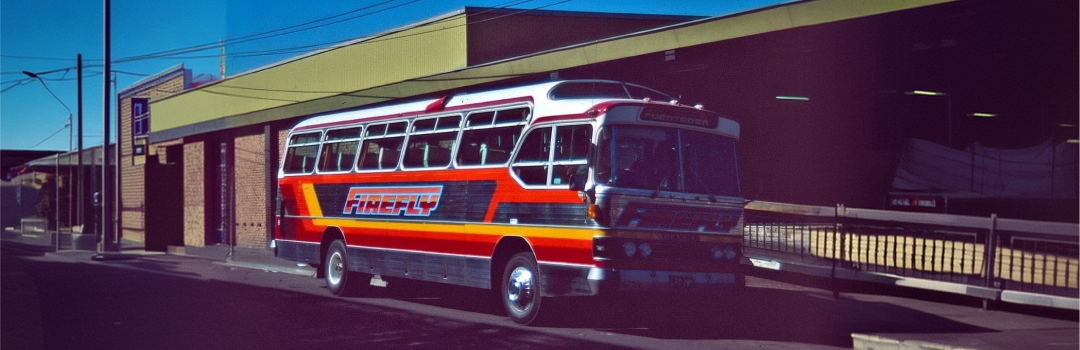
One full coach takes dozens of cars off the road - so here's why coach travel matters, and why we've kept doing it for 60 years.
Where Firefly started
Firefly was founded in 1966, and the same family has run it ever since. The Bono's.
Sitting down with Justin and Adrian Bono they explain, "Dad and our grandparents came over from a foreign country with just a suitcase and a pair of shoes - basically started with nothing. "What they built here is what the next generation grew up knowing - Washing buses at ten, eleven, twelve. Learning to drive them around the yard - parking them in the wash bay to be fuelled and cleaned - years before having a licence. In a family business, you don't get hired. You get raised into it'"
The first brand-new coach arrived in 1985, working subcontracted routes for the established operators of the day. But there was a gap nobody was filling: a dedicated overnight service between Melbourne and Sydney. So in 1986, the family launched it - every night, both directions, Melbourne to Sydney and back.
Adelaide followed two years later.There were no apps back then. No live tracking. No way to check whether a service was running on time, or running at all. The coaches waited on Spencer Street, and people trusted Firefly to show up - which it did, seven nights a week.
Sixty years and three generations on, that trust is still the whole job, and now it's the boys' turn to carry it. The buses that got washed by hand in those early days have given way to a modern fleet, lowering emissions and improving fuel economy, as the family looks for new ways to keep moving for the next sixty years.
Because as they put it: "If you're static, you go nowhere."
Coach travel exists because moving 30 or 40 or 50 people in one vehicle uses less road, less fuel, and less space than moving them in 30 or 40 or 50 separate cars.
That's the mechanism.
Everything else - the emissions story, the cost story, the congestion story - flows from that single operational fact. Transport is responsible for around 23% of Australia's total emissions, and passenger cars plus light commercial vehicles make up roughly 60% of that figure (DCCEEW, Australia's Emissions Projections 2025).
Cars dominate that picture not because they're inherently inefficient, but because the average Australian car carries only 1.4 passengers (BITRE). Most of the fuel a car burns is moving an empty seat. Coach travel inverts that maths - fill a 50-seat coach to a typical load and the per-person fuel use drops sharply, because the engine, the chassis, and the road space are shared across every passenger on board.
Per passenger, coach travel produces lower emissions than driving solo on the same route.
The reason is the one we've already set out: one vehicle, many passengers, everything shared. Here's the maths - Industry benchmark for coach: around 33.5g CO2 per passenger kilometre
Industry benchmark for petrol cars: around 195-206g CO2 per passenger kilometre at that same 1.4 average occupancy That's roughly six times less per passenger for coach versus a typical petrol car carrying one or two people. These are industry-benchmark figures rather than Firefly-specific measurements, but the mechanism behind them is exactly how every Firefly service runs: one vehicle carrying a coach-load of passengers, instead of dozens of cars each carrying one or two.
Take that same 1.4 average and divide a full 50-seat coach by it, and you get about 36 cars' worth of people moving in a single vehicle. Coaches rarely run dead empty or packed to the last seat, so the honest range matters: at a typical 70 percent load that's around 25 cars, and at 90 percent around 32.
However you load it, one coach means dozens fewer cars, less traffic and lower tailpipe emissions between Melbourne, Sydney and Adelaide.
Coach travel produces significantly lower per-passenger emissions than flying the same domestic route.
International benchmarks place domestic short-haul flights at around 246g CO2 per passenger kilometre (UK DESNZ 2024 conversion factors via Our World in Data). Industry-benchmark coach figures sit at around 33.5g per passenger kilometre. That's roughly seven times less per passenger for coach.
Two things to keep in mind. First, coach takes longer than a flight - that's the trade-off. Second, the emissions gap between coach and flight is wider on shorter domestic routes, because take-off and landing carry a disproportionate share of a flight's total emissions.
Coach travel can work out cheaper than flying, especially with Firefly fares from $60 and no hidden extras.
There are no card surcharges, no baggage charges and no booking fees on top of the fare you see. Travelling overnight can also save you a night's accommodation, since you arrive in the morning rather than paying to fly in the day before.
Airfares advertise low and climb fast once you add baggage, seat selection and booking fees. Firefly works the other way: fares start from $60, you carry up to 45kg of luggage included, and the price you see is the price you pay - no card surcharges, no baggage charges, no surprise booking fees.
Firefly currently runs coach services between Melbourne, Sydney and Adelaide, including the overnight Melbourne to Sydney service it has run since 1986.
Each coach seats up to 50 passengers, depending on configuration. The fleet runs on a mix of Euro 5 and Euro 6 engines - currently around a 50/50 split, moving to roughly 40/60 in favour of Euro 6 over the next few months as older vehicles are replaced.
We'll keep this page updated as the fleet evolves and the data is refreshed - stay tuned!
Firefly reduces its emissions in three ways: a fleet being modernised to higher engine standards, cleaner-burning fuel, and lower-emission practices at our depots.
Here's the detail on each, including what every measure does and doesn't do.
These fleet measures work on two fronts: carbon, through fuel efficiency and fleet renewal, and local air quality, through lower NOx, sulphur and particulates.
The Fleet Engine standards - Our coaches run a mix of Euro 5 and Euro 6 engines, currently around a 50/50 split and moving to roughly 40/60 in favour of the cleaner Euro 6 rating as older vehicles are replaced.AdBlue across the whole fleet. Every Firefly coach runs AdBlue (selective catalytic reduction), which reduces nitrogen oxide (NOx).
NOx is a local air-quality pollutant, not a greenhouse gas, so AdBlue cleans up the air around the exhaust. It does not lower carbon.Cleaner fuel. We run extra-low-sulphur diesel, a cleaner-burning fuel than the older high-sulphur diesel it replaces. It produces fewer sulphur and particulate emissions, which is another air-quality gain rather than a carbon one.
Fleet renewal - We progressively replace older vehicles with newer, lower-emission, more fuel-efficient coaches. We use Telematics and driver monitoring and have onboard systems that track fuel consumption and idling, and help us bring both down.
We are always looking at ways to be more sustainable.
We do this through - solar power at our depots - recycling of workshop waste streams and paperless systems and digital records
Last verified June 2026, fleet data supplied by Firefly operations.
Pick a route, pick a date, and we'll see you on board.
Sources and methodology
Every figure on this page is sourced from a primary publication or an industry benchmark report. Where a figure is industry-benchmark rather than Australia-specific, we label it as such inline.
Primary Australian sources: